



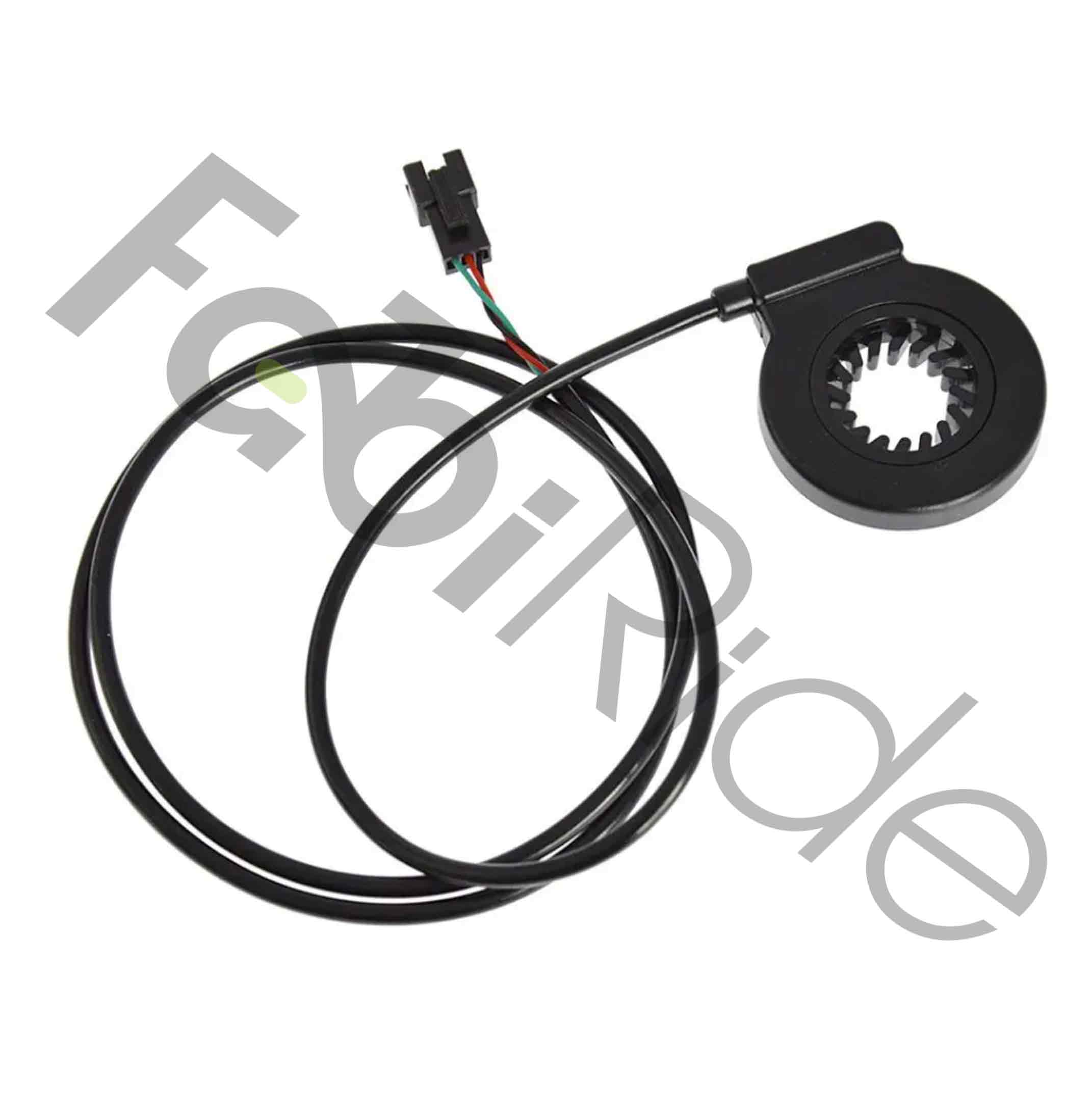
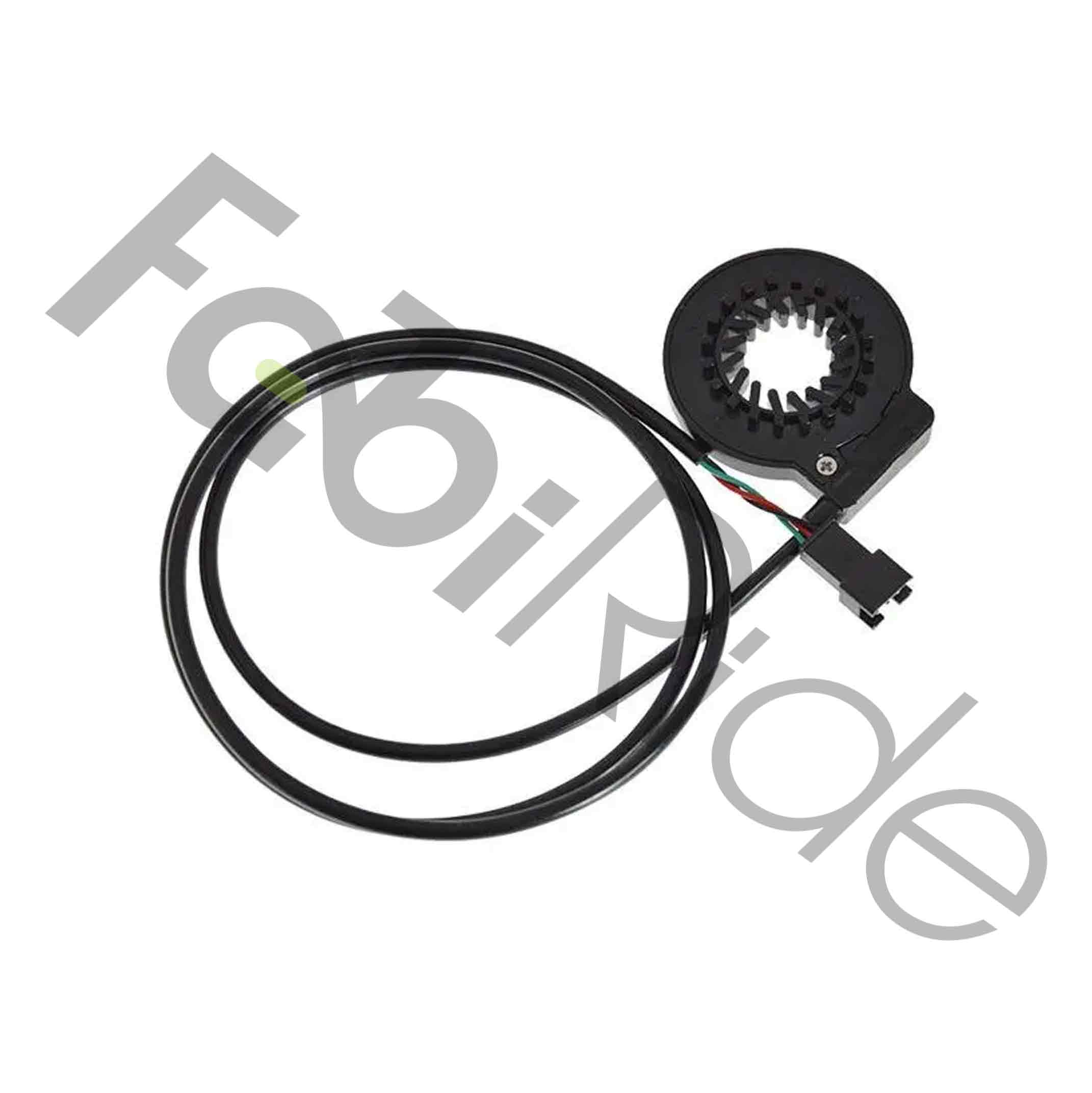
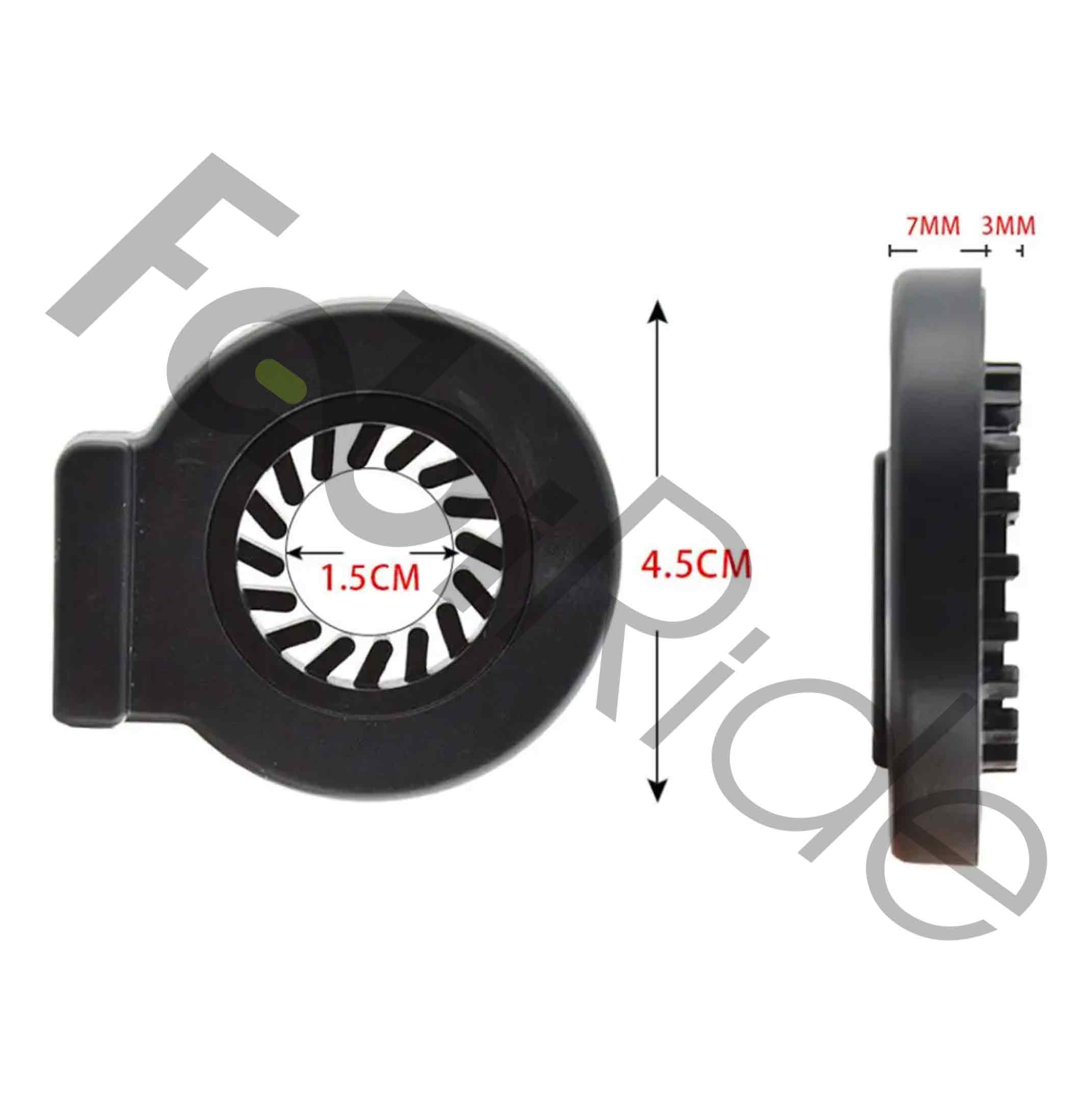
This PAS pedal assist sensor is a closed-type cadence sensor built around a 12-magnet ring. It suits electric bikes and e-bike conversion kits whose controller has a PAS input. Compatibility covers most 36/48 V e-bike controllers, including KT (Kunteng) and Lishui (LSW) units that require a PAS signal.
The sensor detects that the cranks are turning and how fast. It then sends pulses to the controller, which switches on motor assistance according to the selected assist level. Because it reads rotation rather than force, it is a cadence sensor, not a torque sensor. Assistance therefore does not depend on how hard you press the pedals.
Operation is based on the Hall effect. As the rotating magnet ring passes the stationary sensor head, each magnet triggers one pulse. More magnets mean more pulses per crank revolution. With 12 magnets, the controller receives its signal earlier than it would from a 5- or 8-magnet unit.
Key Benefits
- 12-magnet ring – twelve pulses per crank revolution, so the controller reacts to pedalling sooner.
- Smoother assist at low cadence – power comes in gradually as you begin to pedal, without a sudden surge.
- Faster than 5-magnet sensors – the pulse rate is roughly 2.4 times higher.
- Quicker than 8-magnet sensors – the pulse rate is about 1.5 times higher.
- Closed construction – sensor head and magnet ring sit together in a single housing.
- Dust and splash resistant – the housing shields the mechanism from dirt and moisture.
- Standard 3-wire connection – +5 V, GND and signal, matching common controller pinouts.
- Powered by the controller – it draws from the controller PAS line, typically 5 V, so no separate supply is needed.
Who Is This Sensor For?
This sensor is made for electric bicycles and for e-bike conversion kits. Any controller with a PAS input can drive it. That includes KT (Kunteng) controllers, Lishui (LSW) controllers and most other 36/48 V e-bike systems.
It is especially useful if you are assembling an e-bike from a conversion kit. In addition, it works well as a spare part when an older PAS sensor stops responding. Riders who find their existing 5- or 8-magnet sensor too slow also choose this version for the sharper response.
Mounting depends on your frame. The sensor attaches either at the crank arm or at the bottom bracket spindle, whichever the bike layout allows. Note that it is intended for pedal-driven bicycles only. Vehicles without pedals have no PAS system, so the sensor has no application there.
Technical Specifications
| Type | Closed-type PAS sensor (pedal rotation / cadence sensor) |
| Number of magnets | 12 pcs |
| Operating principle | Hall effect sensor |
| Output | Pulse signal to the controller |
| Power supply | Controller PAS line, typically 5 V |
| Wiring | 3 wires: +5 V, GND, signal |
| Housing | Closed construction, dust and splash resistant |
| Compatibility | Controllers with PAS input (KT, Lishui and others), 36/48 V e-bike systems |
| Mounting position | At the crank arm or bottom bracket spindle |
Installation
Fit the sensor so the gap to the magnet ring stays small and consistent. Follow the arrow marked on the ring, since it indicates the direction of rotation. Then connect the PAS, 5 V and GND wires to the matching controller connectors.
Before final tightening, check the system in test mode. Lift the wheel off the ground and turn the cranks gently to confirm the controller responds. A ring fitted the wrong way round reduces sensitivity, so verify the arrow first.
Why Choose a 12-Magnet PAS Sensor?
The practical difference between 5, 8 and 12 magnets is pulse frequency. This unit produces twelve pulses per crank revolution. As a result, the controller recognises that the pedals are turning much earlier in the stroke.
You notice this most when pulling away from traffic lights or starting on a climb. Assistance engages sooner, and transitions between assist levels feel more even. However, more magnets do not add speed, power or range. Only responsiveness and smoothness improve.
The second difference is the enclosed design. Because the sensor head and magnet ring share one housing, the mechanism is less exposed to mud and moisture than open-type alternatives. That matters on a component sitting right beside the bottom bracket.
Frequently Asked Questions
Will this PAS sensor work with my controller?
- It fits any controller with a 3-wire PAS input: +5 V, GND and signal.
- Compatibility is confirmed with KT (Kunteng) and Lishui controllers.
- Most other 36/48 V e-bike controllers accept the same signal.
Does it work with KT and Lishui controllers specifically?
- Yes, both KT (Kunteng) and Lishui (LSW) controllers are supported.
- These controllers expect exactly the pulse signal this sensor produces.
- Simply match the three wires to the controller PAS connector.
Is this a torque sensor?
- No, it is a cadence sensor.
- It registers that the cranks are turning and at what rate.
- Assist output follows your chosen assist level, not your pedalling force.
Will 12 magnets make my e-bike faster?
- No, top speed, motor power and range stay the same.
- The gain is quicker engagement and smoother assist changes.
- Twelve pulses per revolution reach the controller sooner than five or eight.
Where do I mount the sensor?
- Either at the crank arm or on the bottom bracket spindle.
- The right spot depends on your specific frame and crankset layout.
- Keep the gap between sensor and magnet ring small and even.
Does it need its own power source?
- No, the controller PAS line powers it, typically at 5 V.
- The three wires cover power, ground and signal together.
- No extra battery or converter is required.
Can I fit it to a vehicle without pedals?
- No, it is designed for pedal-driven bicycles only.
- Vehicles without pedals have no PAS system at all.
- The sensor has no function in such setups.
How is it protected against weather?
- The closed housing holds sensor and magnet ring together.
- That construction resists dust and splashes.
- Open-type sensors leave the mechanism more exposed.
For anyone building an e-bike from a conversion kit or replacing a worn sensor, this 12-magnet closed-type PAS unit delivers earlier assist engagement on KT, Lishui and other 36/48 V controllers. Wiring stays simple with the standard three-wire connection, and the sealed housing keeps dirt away from the magnets.

There are no reviews yet.