



Sur-Ron tuning guide
From gearing prep to a 50 kW mid-drive: everything you need to know about Sur-Ron tuning - stages, controllers, motors, batteries and road legality.
What Sur-Ron tuning is
Sur-Ron tuning means improving the power, traction and reliability of a stock electric motorcycle (usually the Light Bee X or Ultra Bee) by changing the controller, motor, battery pack, final drive and cooling. Done properly, tuning falls into three stages: from ride feel and gearing prep (Stage 1) to a mid-drive motor on a high-voltage system (Stage 3).
Sur-Ron electric motorcycles are popular for their low weight, quiet PMSM motor and modular design - which is exactly why they respond so well to tuning. The stock Light Bee X runs a 60 V (16S) system, a sine-wave (FOC) controller and a power-limited motor peaking at roughly 8 kW. Its bigger sibling, the Ultra Bee, leaves the factory with a 74 V system and around 21-25 kW peak.
It is important to understand the difference between power tuning and reliability tuning. Some parts (controller, battery, motor) add traction and speed; others (cooling, quality connectors, reinforced drivetrain, brakes) let you use that power safely and for a long time. Good tuning is always systems work - once you raise power, the whole chain has to be matched to it.
The weakest link decides the outcome: a 50 kW motor with stock brakes and thin wiring is not tuning, it is a risk.
Tuning stages: Stage 1-3
The stages are not a factory standard, but a clear logic has settled in across EU workshops. Each stage builds on the previous one - from the cheapest preparation step to a full hardware rebuild.
Preparation
Better throttle response (e.g. Domino), sprocket selection, wiring and cooling check. The stock controller’s power cannot be raised - it has to be replaced.
up to ~8 kWController + battery
A stronger controller (Torp TC500 2.X / eBMX X-9000 V3), a 72 V battery pack, upgraded cooling and QS8 connectors with thicker cable.
~15-25 kWMid-drive
Mid-drive motor (TM40 / TM40 Pro), Torp TC1000 2.X, 60-84 V, reinforced chain, sprockets and brakes.
up to ~50 kW| Stage | What we change | Typical power | Who it suits |
|---|---|---|---|
| Stage 1 · Preparation | Throttle (Domino), gearing, wiring, cooling | factory (~6-8 kW) | Better response, no power increase |
| Stage 2 · Controller + battery | Torp TC500 2.X / eBMX X-9000 V3, 72 V battery, cooling, QS8 | ~15-25 kW | Enthusiasts, active off-road use |
| Stage 3 · Mid-drive | TM40 / TM40 Pro, TC1000, 60-84 V, gearing, brakes | up to ~50 kW | Tracks, experienced riders |
Controllers: Torp vs stock vs eBMX / SiliXcon
The controller (MCU) decides how much phase current reaches the motor - and phase current is what creates traction from low revs. That is why the first real jump in power is usually not the motor, but a stronger controller with a higher-voltage battery.
Stock controller
Reliable, plug & play, fully protected, but the power is locked at the factory and cannot be raised - more power means replacing the controller.
Torp (TC500 2.0 and TC1000)
Torp TC500 2.X - a roughly 25 kW class controller supporting up to 80 V (22S, ~92.4 V fully charged) and keeping the stock functions over the CAN bus. Torp TC1000 2.X - up to 1000 A phase current and up to 60 kW; the pro-level choice, made for the TM40 Pro motor.
eBMX and SiliXcon
eBMX X-9000 V3 (VESC/FOC, 60-84 V, up to 1600 A burst phase current, IP67) delivers the highest phase current - up to 50 kW. It therefore needs a strong battery, clean QS8 wiring and precise tuning. SiliXcon controllers are built for racing - highly configurable, but demanding to set up.
| Controller | Phase current | Max. power | Characteristics |
|---|---|---|---|
| Stock | ~350-400 A | ~6-8 kW (factory) | Plug & play, power locked, not adjustable |
| Torp TC500 2.X | ~700 A | ~25 kW | Up to 80 V (22S), CAN, keeps stock functions |
| Torp TC1000 2.X | up to 1000 A | up to 60 kW | Pro level, suits the TM40 Pro |
| eBMX X-9000 V3 | up to 1600 A | up to 50 kW | Maximum power, needs a strong battery |
| SiliXcon SL / SC | up to ~500 A | 18-36 kW | Up to 84 V, professional tuning, highest precision |
FabiRide builds complex custom systems in-house and programs both ASI and SiliXcon controllers ourselves.
Motors: TM40 Pro and mid-drive solutions
The stock Sur-Ron motor is a mid-mounted PMSM type, dependable for everyday riding but limited in power. Serious Stage 3 tuning replaces the whole motor - the most popular choice being the Torp TM40 and the stronger TM40 Pro.
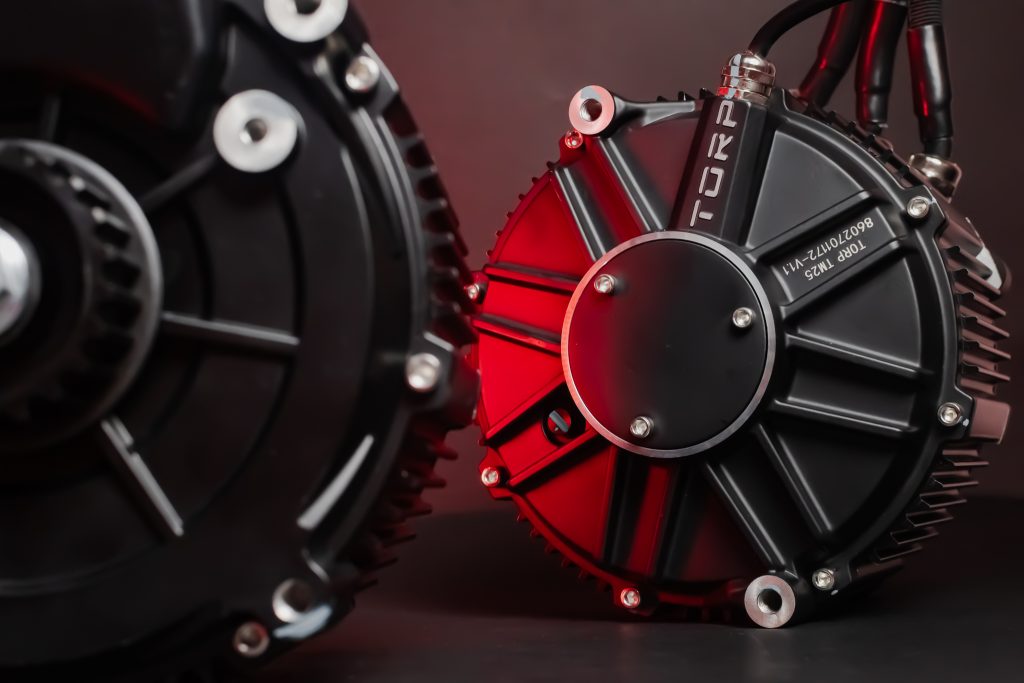
| Motor | Peak power | Nominal | Torque | Max. RPM |
|---|---|---|---|---|
| Stock PMSM | ~6-8 kW | - | ~39 Nm* | 5 400 |
| Torp TM40 | 42 kW | 17 kW | 93 Nm | ~9 000 |
| Torp TM40 Pro | 50 kW | 19 kW | 86 Nm | 11 000 |
*Value at the motor shaft; final torque at the wheel depends on the gearing ratio. The TM40 Pro draws up to ~1100 A phase current, so it requires a matching controller (e.g. the TC1000).
Important: the TM40 and TM40 Pro require the whole bike to be prepared - reinforced chain, sprockets, belt, brakes and a suitable battery. Swapping only the motor without matching the rest of the system quickly ends in failures.
Batteries and voltage: 60 / 72 / 84 V
In a tuned build the battery does two jobs: voltage (volts) mostly determines speed and power, while capacity (Ah / Wh) - determines range. As voltage rises, so does what the system can do:
- 60 V (16S) - the stock Light Bee system, ~67.2 V fully charged.
- 72 V (20S) - the most popular Stage 2 upgrade, ~84 V fully charged.
- 84 V (22S) - Stage 3 level, ~92.4 V fully charged, matched to the TC500/TC1000.
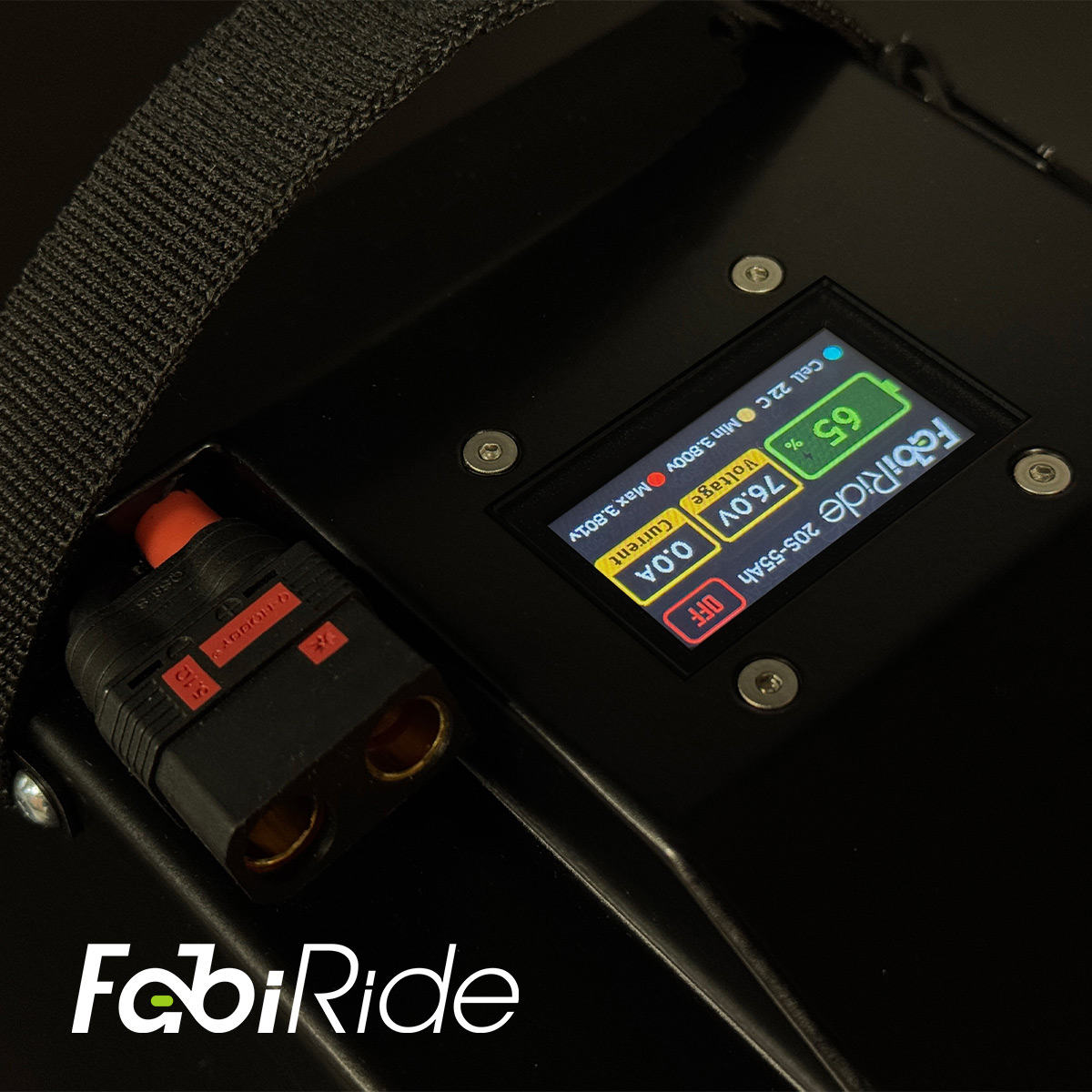
Just as important are the battery’s discharge capability (C-rate) and the BMS - these are what let the controller pull high currents without overheating. FabiRide builds custom lithium-ion packs in our Kaunas workshop and ships them across the EU, so voltage, capacity, cell grade and connectors (e.g. a QS8 6AWG power harness) can be matched precisely to your tuning stage.
Gearing and cooling
Sprockets and chain
The final drive is set by the front-to-rear sprocket tooth ratio. A smaller rear (or larger front) sprocket raises top speed, but reduces low-end pull; the opposite combination gives more traction and hill climbing. Once power goes up, it is worth choosing a reinforced chain and sprockets that can take the extra torque.
Cooling and the thermal limit
More current means more heat in the motor and the controller. An overheated controller starts cutting power automatically (thermal derating) - so higher stages need better cooling, good thermal contact and the right cable cross-section. Cooling is often what separates a bike that is fast for one lap from one that is fast all day.
Safety and reliability
As power rises, every stage has to be matched by an upgrade of the safety components. Recommended order:
- Brakes - larger discs, better pads from Stage 2 on.
- Tyres and wheels - tread and compound suited to the surface.
- Connectors and cable - QS8 connectors, 6AWG harnesses instead of thin stock wiring.
- BMS and fuses - protection against overload, short circuit and overheating.
- Frame and steering joints - inspection, since vibration and loads increase.
Power that is reliably installed matters just as much as the power itself. A poor connector or an overheating cable can stop even the most expensive system.
Riding on public roads
Across the EU, an electric bike or motorcycle whose power exceeds certain limits is classed as a moped (L1e) or a motorcycle (L3e) and becomes a registrable vehicle. It is worth understanding this before planning a tuning project.
L1e (moped) class - the main limits
- Max. motor power up to 4 kW, design speed up to 45 km/h.
- Mandatory registration with your national authority and vehicle insurance.
- At least an AM category licence (minimum age and testing vary by country).
- A mandatory helmet to an EN/ECE standard; fines for riding without one vary by country.
In practice, tuning at most stages exceeds the L1e limits, so such a Sur-Ron can no longer be registered as a moped and is intended for closed tracks and private land. If you need public-road use, power and speed limits must meet L1e (or L3e with the matching registration). Always check the exact conditions against the rules in your own country - this is general information, not legal advice.
What Sur-Ron tuning costs
There is no single price - the cost of tuning depends on the stage chosen, the class of components and the amount of work involved. The same Stage 2 can vary widely depending on battery capacity or controller model. Below are the main factors that drive the cost:
| Factor | Effect on cost |
|---|---|
| Tuning stage (Stage 1-3) | Largest - it defines the whole scope |
| Controller class (OEM vs Torp / eBMX / SiliXcon) | Medium-high |
| Battery voltage and capacity (Ah) | High |
| Whether the motor is replaced (TM40 / Pro) | High |
| Upgrading gearing, brakes, cooling | Medium |
| Amount of work and system tuning | Medium |
Since every project is individual, the most accurate figure comes after a short consultation about your model and goals. Call +370 604 15255 or write to us, and we will put together a quote - we ship parts across the EU and worldwide.
How to choose a tuning workshop
Tuning quality depends less on the parts than on who fits and configures them, and how. When choosing a workshop, look for:
- A real workshop with proper equipment, not just component resale.
- Experience in controller tuning and programming (Torp, eBMX, SiliXcon).
- A warranty on the work and a clear, transparent process with a quote up front.
- The ability to build battery packs and custom systems in-house.
- References and real builds, not just marketing promises.
FabiRide was among the first workshops in Lithuania to build custom electric-motorcycle tuning and repair, and the first in Lithuania to officially integrate ASI controllers into Sur-Ron and Talaria. In our Kaunas workshop (S. Raštikio g. 28) we tune Sur-Ron, Talaria and Eride Pro, handle electronics, BMS and controller work and build custom Li-ion battery packs. We ship parts across the EU and worldwide, and take in bikes and components sent to us for repair and programming.
Frequently asked questions
Can a Sur-Ron be tuned without changing the motor?
Yes. Power comes with Stage 2 - a stronger controller with a 72 V battery; the stock motor still copes with that. Stage 1 does not raise power, it only improves response and gearing. The motor (e.g. the TM40 Pro) is only swapped at Stage 3, when you are aiming at the 40-50 kW level. FabiRide were among the first in Lithuania to start Sur-Ron power upgrades and the first to officially integrate ASI controllers into Sur-Ron and Talaria. SiliXcon controllers we program and configure in-house.
How much power can safely be added with the stock motor?
With the right controller, a 72 V battery and better cooling, the stock Sur-Ron motor runs reliably at roughly 15-25 kW peak. Beyond that limit it is safer to move to a mid-drive motor (TM40 / TM40 Pro) to avoid overheating and failures.
Is a Torp controller compatible with the stock display and functions?
Yes. Torp controllers (e.g. the TC500 2.0, TC1000) connect over the CAN bus and keep the stock Sur-Ron functions and readouts, working as a plug & play upgrade. The eBMX X-9000 V3 and SiliXcon, by contrast, unlock more power and tuning scope and therefore need professional setup.
Do the brakes need changing after tuning?
Recommended from Stage 2 on. More power and speed demand matching braking - larger discs and better pads. Safety components (brakes, tyres, connectors) must always catch up with the power you add.
Can a tuned Sur-Ron be registered and ridden on public roads?
Only if it stays within the L1e moped limits: up to 4 kW and 45 km/h, with registration, insurance and at least an AM category licence. Tuning at most stages exceeds those limits, so such a bike is intended for closed tracks and private land. Check your own national rules.
How does the tuning work actually happen?
We work in stages. It starts with inspection and diagnostics: we assess the condition of the motor, battery, wiring and brakes and what you want to achieve - either from the details you send us, or from the bike itself once it arrives at our workshop. From there we choose the stage - Stage 1 (preparation: throttle, gearing, wiring, cooling), Stage 2 (a stronger controller with a 72 V battery) or Stage 3 (a mid-drive motor on a high-voltage system). We send a quote before any work and start only once you approve it. Every stage ends with load measurements and a test ride, and we ship the bike or parts back to you. All our work and parts are covered by warranty.
Do you build custom battery packs for the Sur-Ron?
Yes. FabiRide builds custom lithium-ion packs in our Kaunas workshop and ships them across the EU - we can match voltage (60 / 72 / 84 V), capacity, cell grade, BMS and connectors (e.g. QS8 6AWG) precisely to your tuning stage and how you ride.
Planning a Sur-Ron build?
From Stage 1 fine-tuning to a full Stage 3 with a TM40 Pro and a custom battery - we will put together a solution for your goals and budget, and ship it to you.
Controllers we work with
We configure, program and replace the most advanced electric-motorcycle motor controllers - in the FabiRide workshop in Kaunas. We work with most controllers on the market, and ASI BAC and SiliXcon controllers we program and match to any motor, so the whole system runs smoothly.
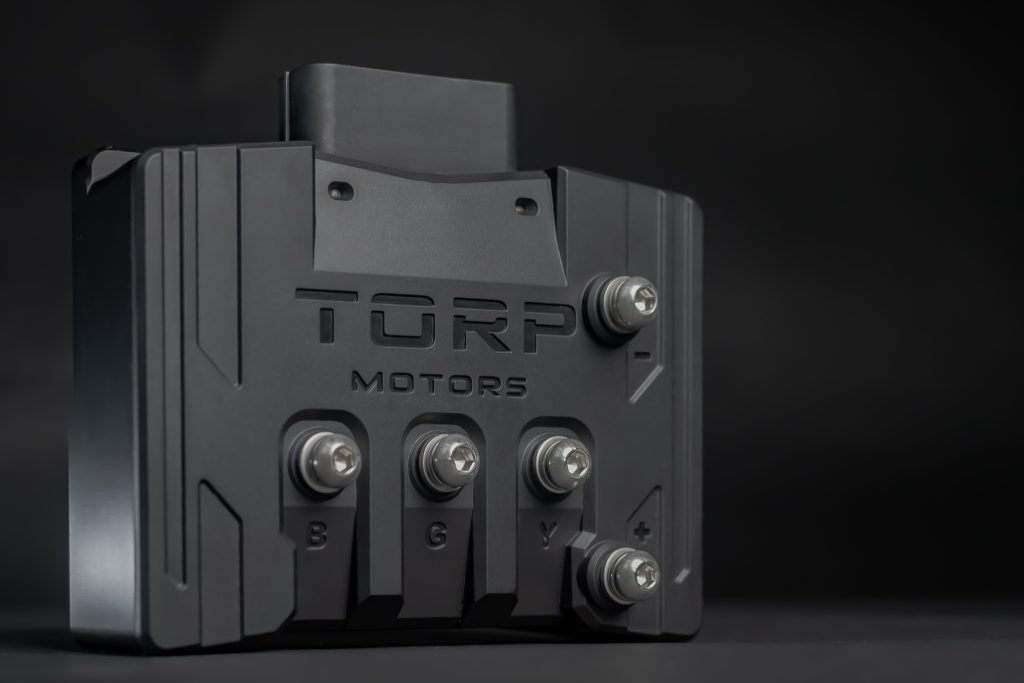 Torp TC500 2.X / TC1000 2.X FOCPlug-and-play power upgrade with Bluetooth tuning - from 25 kW (TC500) to 60 kW (TC1000).
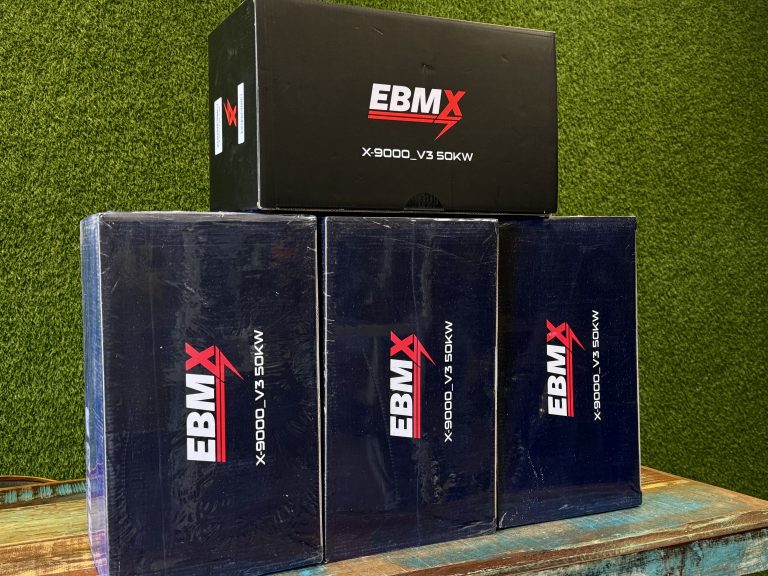 eBMX X-9000 V3VESC/FOC, up to 50 kW and up to 1600 A burst phase current, IP67 - for high-power builds.
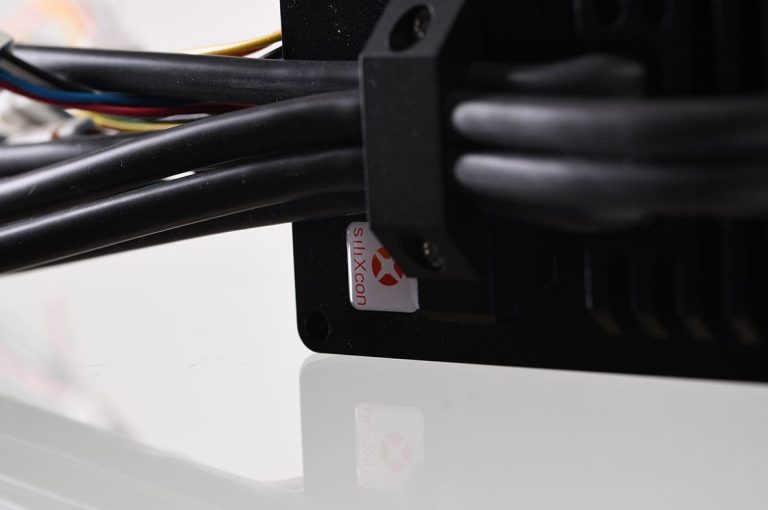 SiliXcon SL / SC / AMRuns on its own platform with the manufacturer's software. We program and match it to the motor - 18-36 kW.
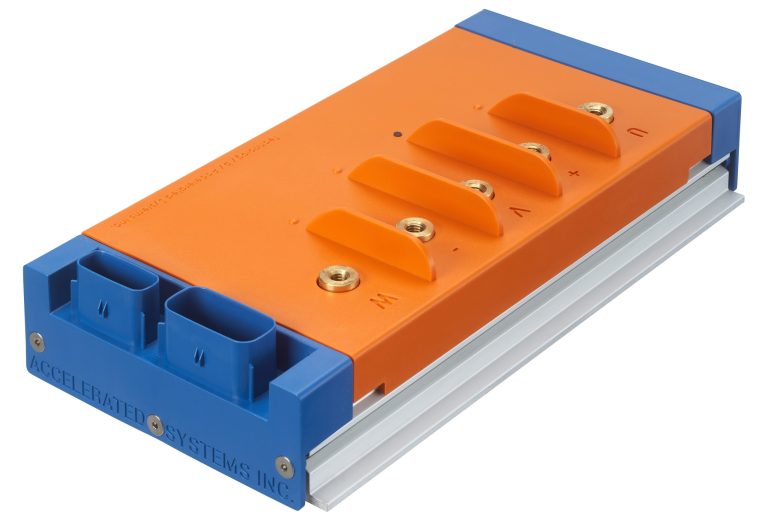 ASI BAC4000 / BAC8000Race-class FOC controllers, 17-32 kW. We program and match them to any motor.
Models: Sur-Ron Light Bee X · Ultra Bee · Storm Bee
Related pages
More on Sur-Ron tuning, repair and electronics from the FabiRide workshop in Kaunas.
