



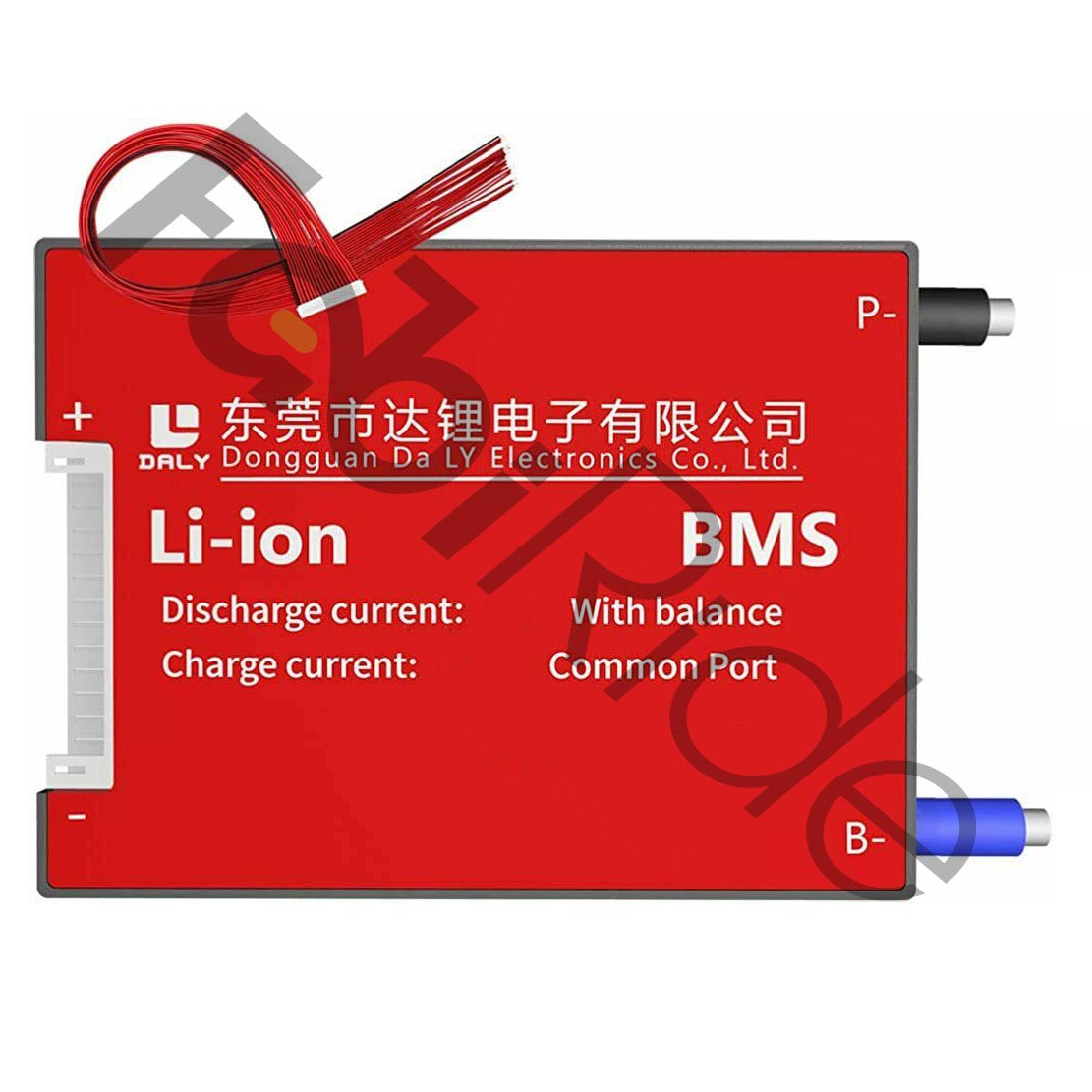
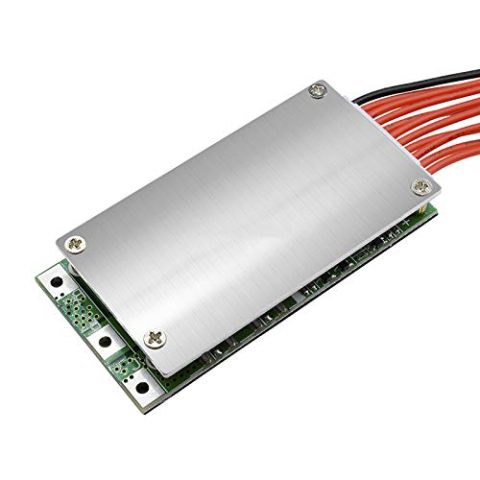
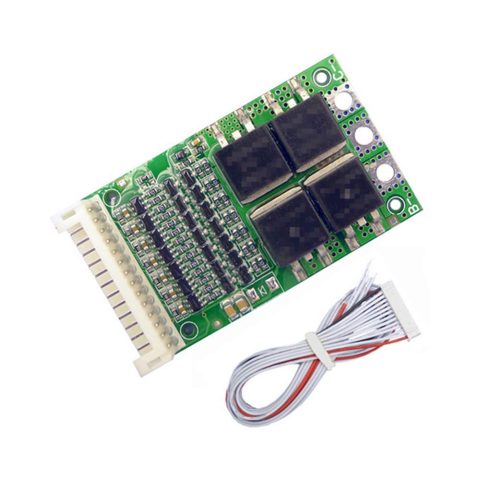
The BMS 16S 60V 40A is a lithium battery protection board (battery management system) built for e-bikes, electric scooters, go-karts, light electric vehicles and DIY energy storage packs. It manages a 16S Li-ion or LiPo pack assembled from 18650 or 21700 cells. Furthermore, it handles up to 40 A of continuous discharge current.
Charging and discharging both run through a single shared C− terminal. As a result, there is no separate P− terminal on this board. That single-path layout keeps the wiring harness shorter inside the battery case.
16S means 16 cells wired in series. Nominal pack voltage is roughly 59.2 V, while a fully charged pack reaches 67.2 V. The market calls this class a 60 V system. Therefore you must charge with a 67.2 V CC/CV charger, not a 60 V one. For LiFePO4 chemistry, check the voltage thresholds separately, because a 16S LiFePO4 pack tops out near 58.4 V.
Key Benefits
- Shared C− port — charging and discharging use the same terminal, so you route fewer wires and connectors.
- Simpler installation — fewer connections mean fewer wiring mistakes and faster diagnostics.
- Overcharge protection — limits voltage once the pack reaches the full 67.2 V level.
- Over-discharge protection — stops cells from dropping below their safe lower limit.
- Overcurrent protection — trips once current exceeds the 40 A continuous rating.
- Short-circuit protection — disconnects the circuit during a fault condition.
- Passive balancing — evens out cell voltages at the end of charging, so the pack lasts longer.
- Steady 40 A discharge — enough for daily riding and for steeper climbs.
Who Is This Board For?
This protection board suits electric bicycles, electric scooters, go-karts and light electric vehicles. In addition, it fits DIY energy storage packs that you assemble yourself. The supported chemistry is 16S Li-ion or LiPo built from 18650 or 21700 cells.
LiFePO4 packs work only when the BMS thresholds match that chemistry. At 40 A discharge, the system power class sits around 2 kW. Consequently, the board targets pack builders, workshops and experienced makers assembling 60 V class batteries. If your controller demands high peak currents, choose a higher amperage BMS instead.
Technical Specifications
| Cell configuration | 16S — 16 cells in series |
| Chemistry | Li-ion / LiPo (18650, 21700); LiFePO4 only with adjusted thresholds |
| System class | 60 V |
| Nominal voltage | ~59.2 V |
| Full charge voltage | 67.2 V (Li-ion) |
| LiFePO4 full charge | ~58.4 V (16S) |
| Max continuous discharge | 40 A |
| Peak current | Per the specific model datasheet |
| Balancing | Passive, typically 30–100 mA |
| Terminals | B−, C− (common), balance connector |
| Balance leads | B1…B16 |
| Protections | Overcharge, over-discharge, overcurrent, short circuit |
| Operating temperature | ~−20…60 °C |
How to Wire It Up
Connect B− directly to the battery negative terminal. C− becomes the shared point for the charger negative and the controller and motor negative. The pack positive usually runs straight from the battery to the system per the wiring diagram.
The balance leads B1…B16 attach in strict order to each cell junction. That sequence is the most critical moment of the whole build. Swapping two leads can destroy both the board and the pack. Also make sure the board gets ventilation plus insulation from vibration and moisture.
Why Choose This BMS 16S 60V 40A?
The main difference from separate port boards is the shared C− terminal. There is no dedicated P− terminal here, because charge and discharge follow one path. That design fits packs where the charging socket and the controller feed connect at the same point.
Fewer wires also make a tidier harness, which speeds up fault finding inside the case. Meanwhile, the 40 A continuous rating matches roughly 2 kW class systems at 60 V.
Frequently Asked Questions
Which charger does this board need?
- Use a 67.2 V CC/CV charger for a 16S Li-ion pack.
- A 60 V charger will not fully charge the pack.
Will it work on my electric scooter or e-bike?
- Yes, it is designed for e-bikes, e-scooters, go-karts and light electric vehicles.
- Your pack must be 16S and your system must be 60 V class.
Can I use it for a go-kart or a DIY power bank?
- Go-karts and DIY energy storage packs are both listed applications.
- Keep continuous draw within the 40 A rating.
Does it support LiFePO4 cells?
- Only when the BMS thresholds are set for that chemistry.
- A 16S LiFePO4 pack charges to about 58.4 V instead of 67.2 V.
Why is there no P− terminal?
- This is a common port design, so C− serves both charging and discharging.
- The terminals available are B−, C− and the balance connector.
What cells can I build the pack from?
- 18650 or 21700 Li-ion and LiPo cells in a 16S arrangement.
- Balance leads run B1 through B16.
How strong is the balancing current?
- Balancing is passive, typically 30–100 mA.
- It works at the end of the charge cycle.
In short, this board covers a 16S 60 V pack with 40 A of continuous discharge and a single shared terminal for both directions of current. Its operating range spans roughly −20 to 60 °C. Pack builders and workshops assembling 60 V class batteries will find the wiring straightforward, provided the balance leads go on in the correct order.
There are no reviews yet.