



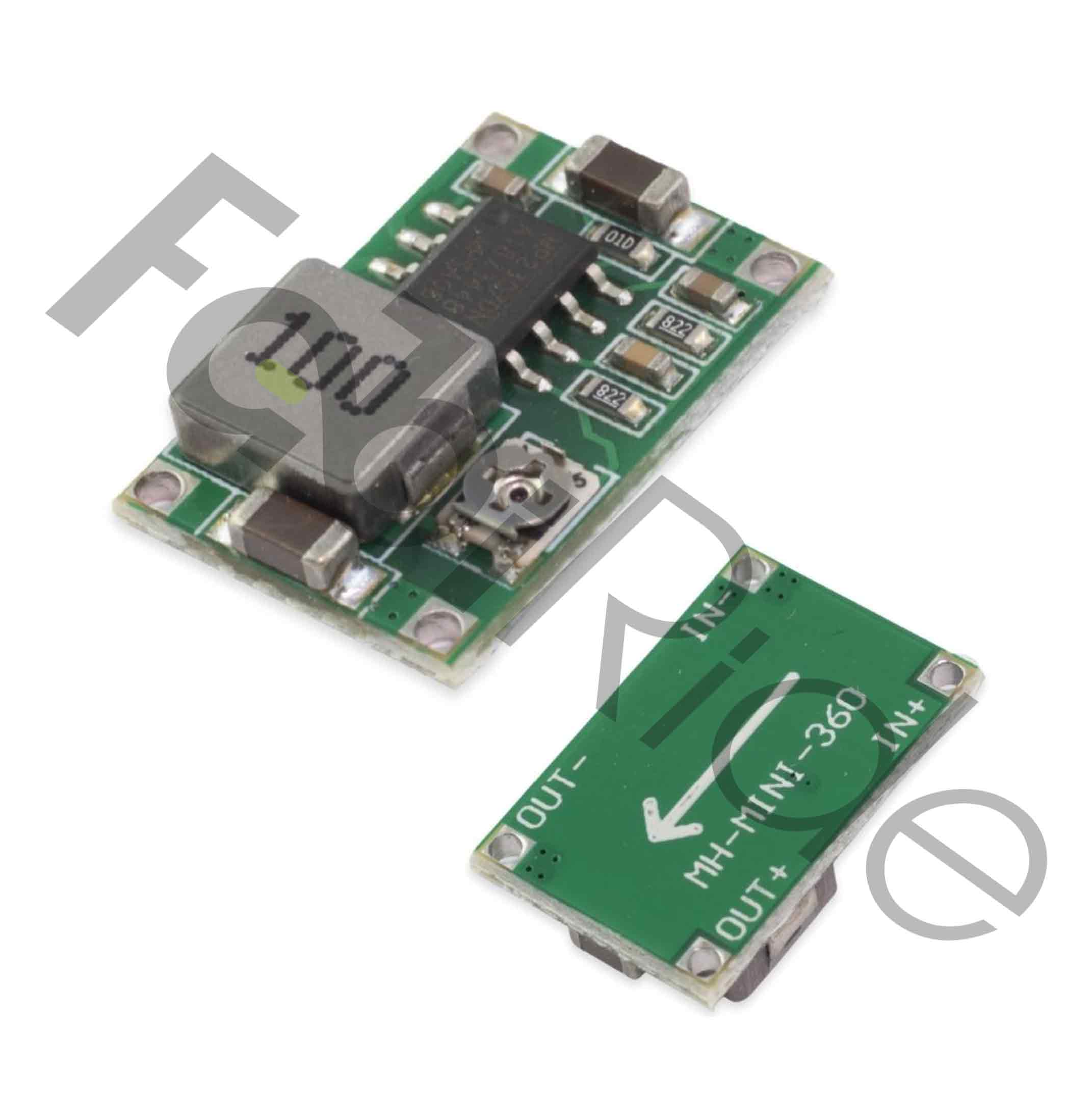
The MXH Mini 360 is an adjustable step-down (buck) DC-DC converter that powers e-bike and e-scooter lights, controller peripherals and sensors. It also feeds Arduino, ESP and Raspberry Pi boards from a higher system voltage. The module accepts 4.75-23 V DC at the input and delivers a 1.0-17 V regulated output.
Efficiency reaches up to 96 %, while the board measures only 12 × 18 × 5 mm and weighs roughly 1 g. Because this is a switching regulator, heat losses stay far lower than with a linear regulator. Therefore the module runs cooler under the same load.
You set the output voltage with the onboard adjustment potentiometer (trimmer) using a small screwdriver. As a result, one 12 V or 24 V system can supply a precise 5 V or 3.3 V rail. The converter handles 1.8 A continuous current and 3 A maximum short-term current. Its operating range of -40…+85 °C also suits equipment used through the cold season.
Key Benefits
- Wide input range – works from 4.75 V to 23 V DC, so it fits 6 V, 12 V and 24 V systems.
- Adjustable output voltage – any value between 1.0 V and 17 V can be dialled in.
- Efficiency up to 96 % – this peak figure appears at a favourable input-to-output ratio with a suitable load.
- Current capacity up to 3 A – the short-term limit is 3 A, while continuous working current is 1.8 A.
- Compact 12 × 18 × 5 mm board – it fits inside a light housing or at a wiring harness connector.
- Weight of about 1 g – the mass barely changes the total weight of the assembly.
- Operating temperature -40…+85 °C – a broad interval for outdoor equipment.
- Switching topology – less heat than a linear regulator at the same voltage difference.
Who Is This Converter For?
The MXH Mini 360 powers front and rear lights on electric bikes and electric scooters. In addition, it feeds controller peripherals and sensors whenever the main system voltage sits too high for them. This makes it a practical building block for e-mobility wiring.
In electronics projects, the module supplies Arduino, ESP and Raspberry Pi boards along with other 5 V and 3.3 V logic circuits. It also suits car and motorcycle accessories such as USB sockets, LED lighting and add-on modules. For example, a 12 V battery becomes a stable 5 V rail for control electronics.
DIY builders and prototype developers choose this board as well. Small size and high efficiency matter most in those projects. Consequently, the module replaces bulkier power supplies inside tight enclosures.
Technical Specifications
| Type | Step-down DC-DC converter (buck) |
| Input voltage | 4.75-23 V DC |
| Output voltage | 1.0-17 V, adjustable |
| Maximum (short-term) current | 3 A |
| Continuous current | 1.8 A |
| Efficiency | up to 96 % |
| Output adjustment | Adjustment potentiometer (trimmer) |
| Operating temperature | -40…+85 °C |
| Dimensions | 12 × 18 × 5 mm |
| Weight | ~1 g |
Installation Notes
- Thermal headroom – provide ventilation or a heatsink when the load approaches 1.8 A.
- Polarity – follow the VIN and VOUT markings and pick an adequate wire cross-section.
- Capacitors and fuse – add input and output capacitors or a fuse if the system reacts badly to voltage spikes.
- Set it without load – adjust the output with no load attached, measure it with a multimeter, then connect sensitive electronics.
Why Choose the MXH Mini 360?
The board footprint is just 12 × 18 mm. Therefore it slots into places where standard-size power modules simply will not go, such as a light housing or the space beside a controller connector. Its 1 g mass adds nothing meaningful to a harness.
Efficiency of up to 96 % means smaller losses than a linear regulator produces. Because of that, the module stays cooler while driving the same load. At 1.8 A of continuous current, however, planning for heat dissipation is still worthwhile.
One module covers the whole 4.75-23 V input span. Furthermore, a single board serves both 5 V and 12 V outputs, since the trimmer sets the level. That flexibility reduces the number of spare parts you need to keep on the bench.
Frequently Asked Questions
Can I power 5 V logic from a 12 V battery?
- Yes. Set the MXH Mini 360 to a 5.0 V output from a 12 V input.
- Adjust the trimmer without load first, then verify the value with a multimeter.
Is it suitable for e-bike and e-scooter lights?
- Yes. The module was intended for front and rear lights on electric bikes and scooters.
- It drops 24 V or 12 V system voltage to the level your light needs.
Will it run an Arduino, ESP or Raspberry Pi board?
- Yes. It supplies 5 V and 3.3 V logic circuits from a higher input voltage.
- Keep the continuous draw at or below 1.8 A for stable operation.
How much current can it deliver?
- Continuous working current is 1.8 A.
- The maximum short-term current is 3 A.
How do I set the output voltage?
- Turn the onboard trimmer with a small screwdriver.
- Any value between 1.0 V and 17 V can be selected.
Does it get hot in use?
- The switching design produces less heat than a linear regulator at the same voltage drop.
- Near 1.8 A, add ventilation or a heatsink.
Can I use it in winter conditions?
- The operating range spans -40…+85 °C.
- That interval covers outdoor vehicles and equipment year-round.
Does it work with car and motorcycle accessories?
- Yes. It feeds USB sockets, LED lighting and additional modules.
- A 12 V vehicle line converts to the voltage the accessory expects.
The MXH Mini 360 turns one wide input range into the exact rail your project needs. Set the trimmer once, confirm the reading, and the 12 × 18 mm board disappears into your build while delivering up to 1.8 A continuously.
There are no reviews yet.