



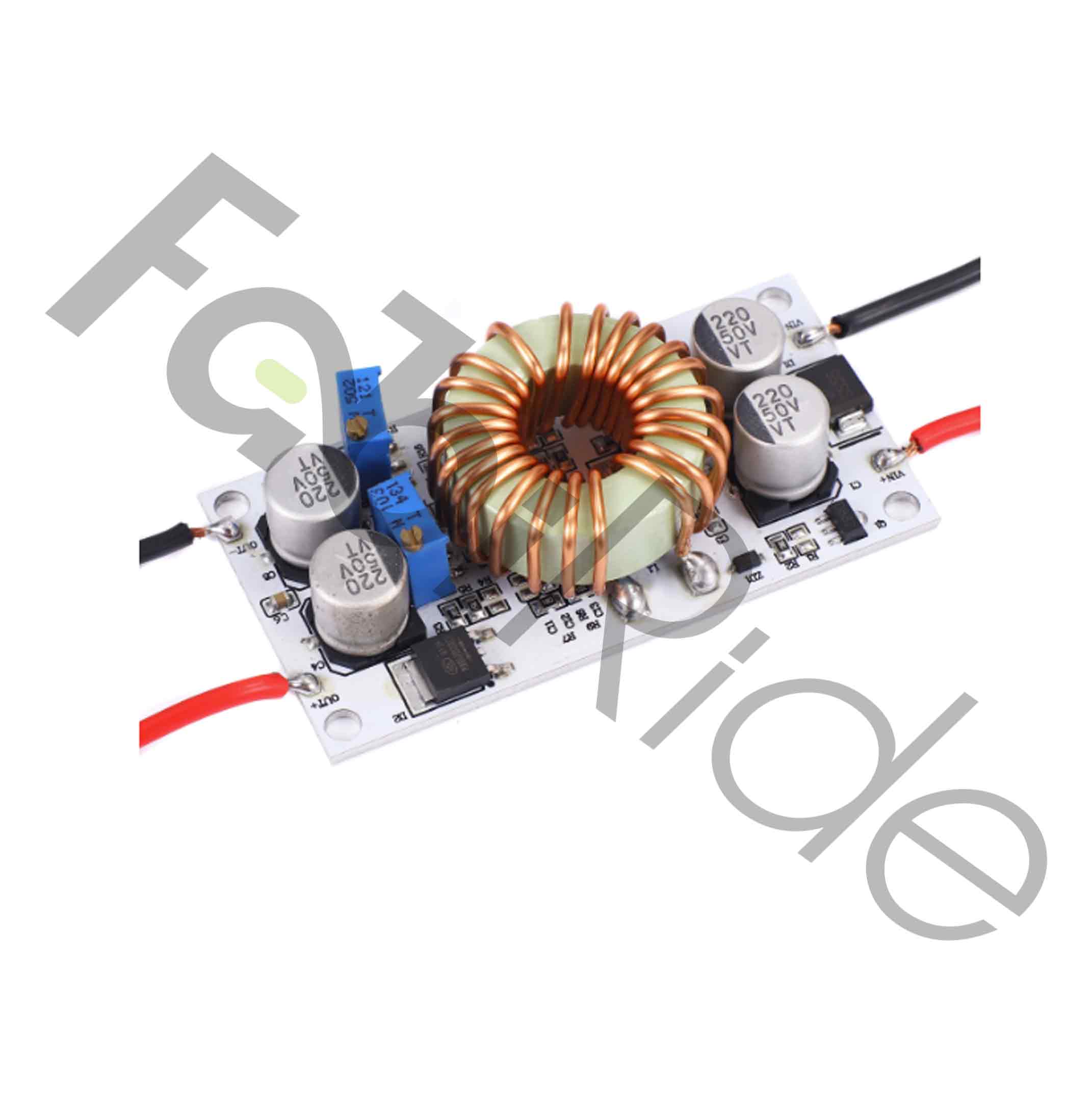
This DC-DC boost converter takes a 9-48 V DC input and raises it to an adjustable 10-50 V DC output at up to 10 A. It was built for e-bike, electric scooter and electric motorcycle projects, LED systems and DIY electronics. In short, it solves the everyday problem of needing a higher voltage than the battery pack actually delivers.
The module works as a step-up converter only. Therefore the output voltage must always sit above the input voltage. For example, you can lift 12 V up to 48 V, but you cannot pull 12 V down from a 48 V source. Keep that rule in mind when planning any circuit.
Output voltage is set with an onboard potentiometer. As a result, one module can serve several different jobs on the same vehicle or bench. It suits lights, controller peripherals, LED strips and inverter supply lines equally well.
Key Benefits
- Wide 9-48 V DC input range – one module works with 12 V, 24 V, 36 V and 48 V battery packs.
- Adjustable 10-50 V DC output – precise trimming with the potentiometer to match the load.
- Up to 10 A output current – achievable with proper cooling and a favourable Vout/Vin ratio.
- Voltage stabilisation – the set output voltage is held once the load is connected.
- Passive or active cooling – choose the method according to the actual load you run.
- Compact module – it mounts easily inside an e-mobility vehicle housing or on a test bench.
- Potentiometer trimmer adjustment – no resistor swapping, no soldering to change the output.
- Broad application range – lights, controller peripherals, test stations and prototypes.
Who Is This For
This converter is aimed at e-mobility builders who work on electric bicycles, electric scooters and electric motorcycles. The most common scenario is powering extra accessories and headlights from a lower battery voltage. Consequently, riders can add lighting without swapping the whole pack.
The second group is LED and electronics work. From a 12 V, 24 V, 36 V or 48 V source, the module produces a stable higher Vout. It also feeds controller peripherals, which sometimes need more voltage than the pack supplies to the auxiliary circuits.
The third area is the lab and DIY bench. Here the converter acts as an adjustable source for testing, test stations and prototype development. Because of that, it fits both permanent installation in a vehicle and temporary use on a bench.
Technical Specifications
| Type | DC-DC Step-UP (boost) converter |
| Input voltage | 9-48 V DC |
| Output voltage | 10-50 V DC, adjustable |
| Max. output current | 10 A with adequate cooling |
| Output adjustment | Potentiometer (trimmer screw) |
| Protection | Varies by batch; an input fuse is recommended |
| Cooling | Passive or active, depending on load |
| Power balance | Pin ≈ Pout / efficiency |
| Applications | E-mobility, LED, electronics, lab, DIY |
Usage Tips
- Set the required output voltage with the potentiometer first, before connecting any load.
- Respect the power balance: as Vout rises, the input current climbs too.
- At high power levels, provide cooling with a heatsink or airflow.
- Fit a fuse on the input side of the module.
- Add capacitors near loads that are sensitive to voltage spikes.
- Never reverse polarity, and use wire of the correct cross-section.
Why Choose This Converter
The 9-48 V to 10-50 V span covers every common e-mobility pack voltage. Therefore you do not need a separate module for each system. One converter handles a 12 V lighting circuit as readily as a 48 V peripheral node.
The 10 A output limit sits well above what small boost modules typically deliver. As a result, the module suits real loads such as LED strips or inverter supply, not just signal-level electronics.
Finally, the adjustable output lets you reuse the same module again and again. This matters most on prototypes, where the final working voltage is still being refined during testing.
Frequently Asked Questions
Can I get 48 V from a 12 V source?
- Yes. 12 V sits inside the 9-48 V input range, and 48 V sits inside the 10-50 V output range.
- Watch the input current, since it rises sharply at higher output voltages.
Can I step 48 V down to 12 V with this module?
- No. This is a step-up converter only.
- The output voltage must always be higher than the input voltage.
Will it power the lights on my e-bike or electric scooter?
- Yes, that is one of its main uses on electric bicycles and scooters.
- It raises the pack voltage to whatever your lighting circuit needs.
Is it suitable for an electric motorcycle build?
- Yes. It works with 12 V, 24 V, 36 V and 48 V packs commonly used in these builds.
- The compact size lets it mount inside the vehicle housing.
How do I actually reach 10 A?
- Provide proper cooling, either a heatsink or forced airflow.
- Keep the Vout/Vin ratio favourable, since a large step-up raises input current.
How is the output voltage set?
- Turn the onboard potentiometer trimmer screw.
- Do this with no load connected, then attach the load afterwards.
Does it hold the voltage under load?
- Yes. The set output voltage is stabilised once a load is connected.
Should I add a fuse?
- Yes, fit a fuse on the input side.
- Protection features vary between batches, so the fuse is your safeguard.
Between the wide input span, the potentiometer-set output and the 10 A current headroom, this module covers most of the voltage-raising jobs that come up in e-mobility and bench work. Set it once for a permanent install, or re-trim it as a prototype evolves.
There are no reviews yet.